

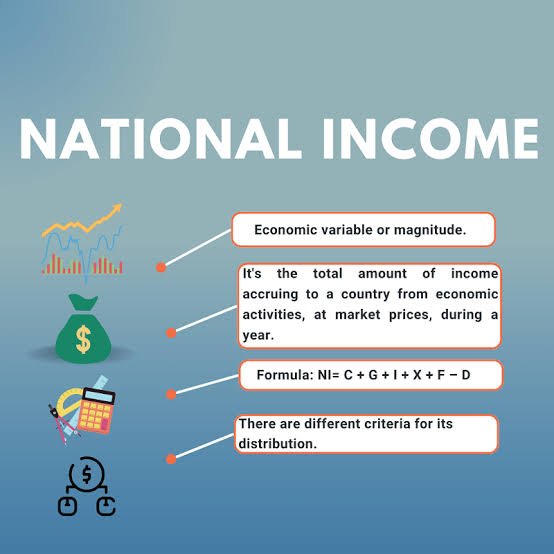
National income refers to the total value of goods and services produced within a country’s borders over a specific period, usually a year. It serves as an essential indicator of a country’s economic performance and helps in analyzing its standard of living, economic growth, and overall economic health. In this blog, we will delve into the concept of national income, its types, and how it is measured.
Types of National Income:
1. Gross Domestic Product (GDP): GDP measures the total value of all final goods and services produced within a country during a specific time period. It includes consumer spending, investment, government expenditure, and net exports (exports minus imports). GDP is the most commonly used measure of national income.
2. Gross National Product (GNP): GNP is similar to GDP but also includes income earned by the country’s residents from abroad and excludes income earned by foreign residents within the country. It considers the income generated by a country’s citizens, whether they are located domestically or overseas.
3. Net National Product (NNP): NNP is derived by deducting depreciation or the wear and tear of capital goods from GNP. It represents the net value of the country’s productive assets after accounting for capital consumption.
Measurement of National Income:
There are two main methods to measure national income: the income approach and the expenditure approach.
1. Income Approach: The income approach calculates national income by summing up all the incomes earned by individuals and businesses within the country. It includes wages, salaries, rents, profits, interest, and other forms of income. This approach focuses on the distribution of income among different factors of production.
2. Expenditure Approach: The expenditure approach measures national income by summing up all the expenditures made on goods and services within the country. It includes personal consumption, investment, government spending, and net exports. This approach focuses on how income is utilized within the economy.
To ensure accuracy, national income measurement involves collecting data from various sources such as surveys, tax records, financial statements, and official government reports. Statistical agencies and economic research institutions play a crucial role in compiling and analyzing this data to estimate national income accurately.
In conclusion, national income serves as a key metric for assessing a country’s economic performance. By understanding the concept of national income, its types, and the methods used to measure it, policymakers, economists, and researchers can gain valuable insights into the overall health and growth of an economy.
 NTA NET PAPER II MANAGEMENT
Leave a comment