Category: Project Management
Introduction:
In the field of project management, effective planning and scheduling play a vital role in the success of any project. Two widely used techniques for project scheduling are PERT (Program Evaluation and Review Technique) and CPM (Critical Path Method). Although both PERT and CPM serve the purpose of project management, they have distinct features and are suited for different types of projects. In this blog post, we will explore the differences between PERT and CPM and understand when to use each technique.
What is PERT?
PERT, or Program Evaluation and Review Technique, is a project management method used to analyze and represent the tasks and activities involved in completing a project. PERT was initially developed for large-scale projects, such as those found in the defense and aerospace industries. It emphasizes the evaluation and estimation of time required for each project activity and focuses on identifying the critical path.
Key Features of PERT:
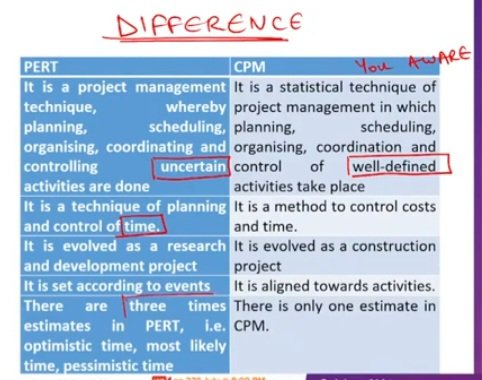
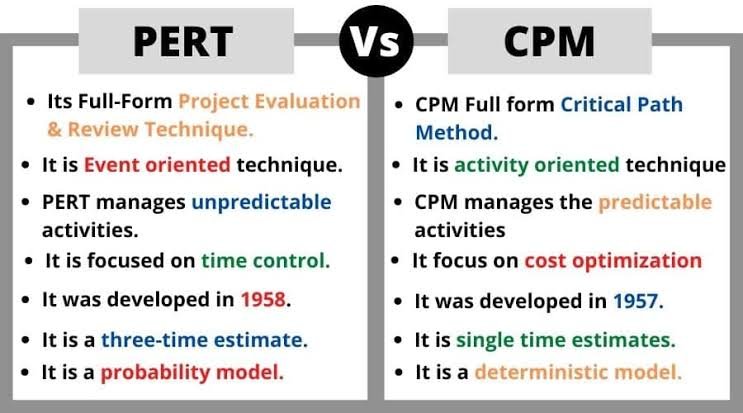
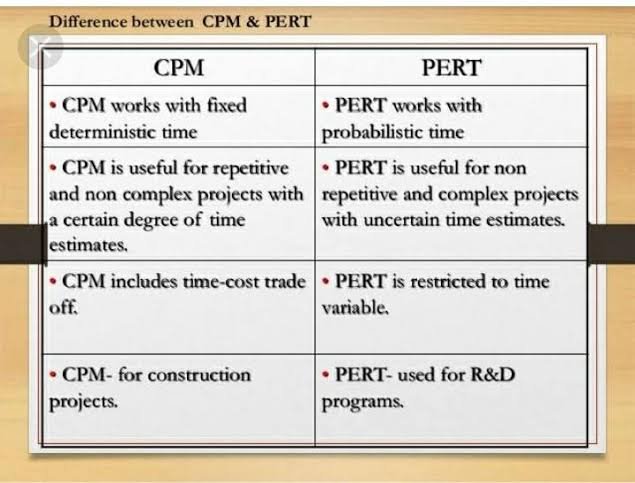
1. Probabilistic Approach: PERT incorporates a probabilistic approach to estimate the time required for each activity. It considers three time estimates: optimistic, most likely, and pessimistic, and calculates the expected time using a weighted average.
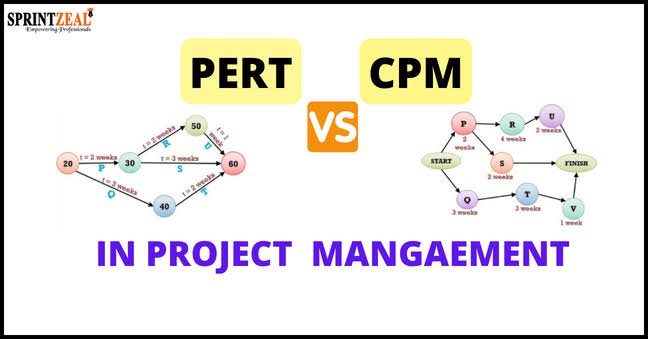
2. Network Diagrams: PERT uses network diagrams to illustrate the sequence of activities and their dependencies. It provides a visual representation of the project’s flow, allowing project managers to identify critical and non-critical paths.
3. Focus on Time: PERT primarily focuses on estimating the time required to complete each project activity and identifies the critical path, which determines the minimum time needed to complete the project.
What is CPM?
CPM, or Critical Path Method, is another project management technique that helps in planning, scheduling, and controlling complex projects. It was developed in the 1950s and is widely used in various industries, including construction, engineering, and software development. CPM places more emphasis on the interdependencies between activities and identifies the critical path for efficient project completion.
Key Features of CPM:
1. Deterministic Approach: Unlike PERT, CPM follows a deterministic approach, meaning it relies on specific time estimates for each activity rather than probabilities. It assumes a fixed duration for each task.
2. Critical Path Identification: CPM identifies the critical path, which is the sequence of activities that determine the project’s overall duration. The critical path represents the longest path through the project network and determines the minimum time required to complete the project.
3. Resource Allocation: CPM takes into account the availability of resources during the project’s execution. It helps project managers allocate resources effectively, ensuring efficient utilization and timely completion of activities.
When to Use PERT and CPM:
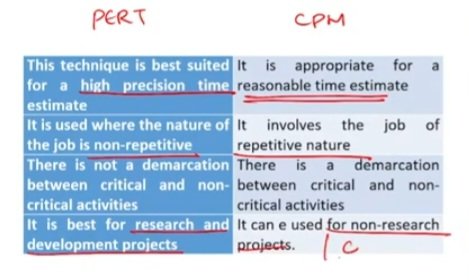
PERT and CPM have distinct applications based on the nature of the project. PERT is suitable for projects with a high degree of uncertainty and tasks that can have varying durations. It is commonly used for research and development projects, where the estimation of activity durations is difficult. On the other hand, CPM is more suitable for projects with well-defined activities and fixed durations. It is often used in construction projects and manufacturing processes where time estimates are relatively certain.
Conclusion:
PERT and CPM are two valuable project management techniques that aid in effective planning and scheduling. PERT’s probabilistic approach and focus on time estimation make it suitable for projects with high uncertainty, while CPM’s deterministic approach and critical path identification are ideal for projects with fixed durations and well-defined activities. By understanding the differences between PERT and CPM, project managers can choose the appropriate technique based on the nature and requirements of their projects, ultimately leading to successful project completion.
Remember to use the appropriate project management technique and apply PERT or CPM accordingly to
 NTA NET PAPER II MANAGEMENT
Leave a comment