Category: Economics & Business
Introduction:
In the realm of market structures, two commonly encountered models are oligopoly and monopolistic competition. While they share certain similarities, they possess distinct characteristics that set them apart. This blog post aims to shed light on the disparities between oligopoly and monopolistic competition through easy-to-understand examples. By grasping the nuances of these market structures, we can better comprehend the dynamics of real-world industries.
1. Oligopoly:
Oligopoly refers to a market structure dominated by a small number of large firms. These firms often possess significant market power and interdependence. Here are some key features of an oligopoly:
– Homogeneous or differentiated products: In an oligopoly, firms may offer either homogeneous products, where products are similar across competitors (e.g., crude oil production by major oil companies), or differentiated products, where firms offer unique features or branding (e.g., smartphones from Apple, Samsung, and Google).
– Strategic interdependence: Oligopolistic firms consider the actions and reactions of their competitors before making business decisions. For instance, when one airline reduces ticket prices, others might follow suit to stay competitive.
Example: Consider the global soft drink industry. Major players like Coca-Cola and PepsiCo dominate the market. These companies offer differentiated products through various brands, marketing campaigns, and flavor variations. They closely monitor each other’s moves to adjust pricing, advertising, and product development strategies.
2. Monopolistic Competition:
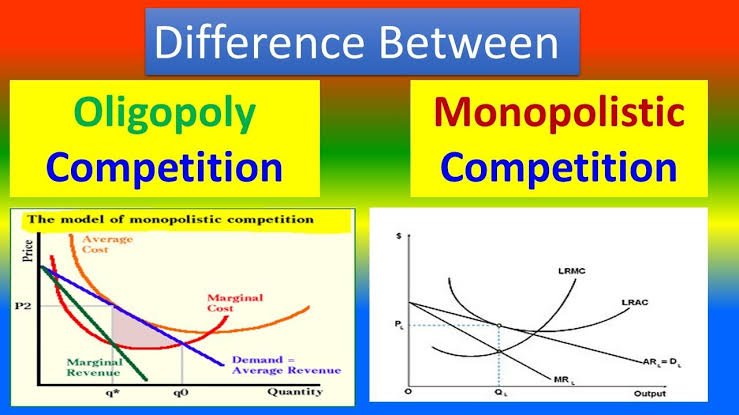
Monopolistic competition represents a market structure characterized by many competing firms, each offering differentiated products. Key features of monopolistic competition include:
– Product differentiation: Firms in monopolistic competition strive to differentiate their products through branding, quality, design, or other unique features. This differentiation allows firms to have some degree of market power.
– Easy entry and exit: Compared to other market structures, monopolistic competition has relatively low barriers to entry, enabling new firms to join the market easily.
Example: Think of the fast-food industry, where multiple chains compete for customers. Each chain differentiates itself by offering unique menus, pricing strategies, restaurant themes, and customer experiences. McDonald’s, Burger King, and Wendy’s are prime examples of firms operating in monopolistic competition.
Conclusion:
While oligopoly and monopolistic competition share the presence of differentiated products, they differ in terms of the number of firms, market power, and strategic interdependence. Oligopoly involves a small number of firms with significant market power, while monopolistic competition encompasses many firms with relatively low barriers to entry. Understanding these differences is vital for comprehending market dynamics, competitive behavior, and consumer choices.
<script async src=”https://pagead2.googlesyndication.com/pagead/js/adsbygoogle.js?client=ca-pub-3482330748000937″
crossorigin=”anonymous”></script>
 NTA NET PAPER II MANAGEMENT
Leave a comment