- Match the terms with the statement given below
List-1
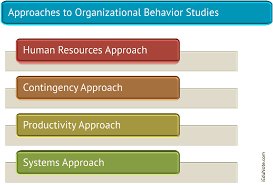
a- Human behaviour results from a continuous and multidirectional interaction between the person and the situation
1-Interactionalism
b) People are central to the organization and they must be developed to their potential
2-Productivity Approach
c) Manager’s efficiency depends on optimum. Contingency 3-utilization of resources d) The belief that there is no one best option available for an organization iv. HR Approach Select the correct option: A. (a)-(i), (b)-(iv), (c)-(ii), (d)-(iii) B. (a)-(i), (b)-(ii), (c)-(iii), (d)-(iv) C. (a)-(i), (b)-(iii), (c)-(ii), (d)-(iv)
D. (a)-(ii), (b)-(i), (c)-(iii), (d)-(iv)Here are the elaborations for each point with real-life examples:
(a) Human behaviour results from a continuous and multidirectional interaction between the person and the situation – Interactionalism:
In real life, human behavior is influenced by both internal factors (personality traits, values, beliefs) and external factors (social environment, cultural norms, situational context). For example, imagine a person attending a job interview. Their behavior during the interview will be shaped by their individual traits, such as confidence, communication skills, and preparation, as well as the specific situation they are in, such as the interviewer’s behavior, the company’s culture, and the interview questions. The interaction between the person and the situation will determine how the individual behaves and responds in that particular context.
(b) People are central to the organization and they must be developed to their potential – HR Approach:
In organizations, the HR approach emphasizes the importance of developing employees to their full potential. This means providing training, opportunities for growth, and creating a positive work environment that fosters employee engagement and satisfaction. For example, a company might offer regular training programs to enhance employees’ skills and knowledge, provide mentorship opportunities for career development, and implement performance management systems that recognize and reward employees’ achievements. By investing in their employees’ development, organizations can enhance productivity, retention, and overall success.
(c) Manager’s efficiency depends on the optimum utilization of resources – Contingency Approach:
The contingency approach suggests that a manager’s efficiency depends on the effective utilization of available resources in different situations. This approach recognizes that there is no one-size-fits-all management style or strategy. For instance, consider a manufacturing plant where a manager needs to oversee production operations. The manager’s efficiency will depend on their ability to assess the specific resources at their disposal, such as machinery, raw materials, and human resources, and make decisions accordingly. They might need to adjust their management approach based on factors like production demands, available workforce, and technological capabilities to ensure optimal resource utilization and achieve production targets.
(d) The belief that there is no one best option available for an organization – Productivity Approach:
The productivity approach suggests that there is no single best option or method for achieving organizational goals. Instead, organizations should continually evaluate and improve their processes to enhance productivity. For example, consider a software development company that aims to increase its productivity. Instead of following a rigid and predefined approach, the company might encourage experimentation and innovation among its development teams. They could adopt agile methodologies, allowing teams to collaborate, adapt, and iterate on their work, based on customer feedback and changing market demands. This approach recognizes that the best way to improve productivity may vary depending on the specific project, team dynamics, and customer requirements.
These real-life examples illustrate how these approaches and beliefs can be applied and observed in various organizational and interpersonal contexts.
https://pagead2.googlesyndication.com/pagead/js/adsbygoogle.js?client=ca-pub-3482330748000937
 NTA NET PAPER II MANAGEMENT
Leave a comment